Biographies A-Z Chief Joseph
The source I chose to explore was Native
American Biographies A-Z, for the entire list of biographies follow this link: http://www.42explore2.com/native3.htm
. I chose Chief Joseph because not only is it an intriguing story, but there were
may links to more content regarding his life. However, only half of the links
worked, only the information provided by pbs.org displayed after following the
links provided. The list of biographies was created by eduscapes.com which is a
website dedicated to lifelong learning which began in 1998.
PBS.org
is a highly credible source compared to most of the other .com weblinks that
failed to work anyway, so it is not surprising to think of reasons why someone
would choose PBS as a source of educational information. An essential quality
of academic resources is understanding sources that are bias compared to unbiased.
360-member stations reach 110 million people through their local stations and
19 million people online (New Research). In our world today, we all know that
profits drive decisions. This is true in media as well as almost any other
business, except the world of public media. PBS utilizes trusted, independent
journalism, and in 2010 was named the nations most trusted institution for the 7th
year in a row (New Research).
Chief
Joseph’s story is well known. After the death of his father who had taken the
name Joseph (his father was one of the first Nez Perce to convert to
Christianity), he was elected to succeed him. He inherited a situation that was
made more and more volatile as white settlers continued encroaching (Chief Joseph).
In 1855 his father made a deal with Washington’s territorial governor set up a
Nez Perce reservation that stretched from Oregon to Idaho. By 1863 following a
gold rush in their given land, the federal government took back almost six
million acres reducing the area previously given to only about one tenth of its
size (Chief Joseph). This betrayal is what sparked the legacy of Chief Joseph.
Joseph
is most well known for disobeying the treaty his father signed by refusing to
leave their Oregon homes until 1877 (Nabokov 130). During the treaty council of
1863 Chief Joseph’s father was unable to be present. Prior to attending in his
father’s place, Chief Joseph was warned by his father who told him to remember
his country, that white men will cheat you of your home, and do not give away
your land (Nabokov 131). During that council meeting, according to Chief
Joseph, a Chief named Lawyer acted without the authority from Chief Josephs band
of Native brothers. The United States claimed to have bought all of the Nez
Perces’ country outside the Lapwai reservation (Nabokov 131).
For
a short time, they returned home to a peaceful life and did not live on the Lapwai
Reservation. When Chief Joseph died he expressed his desire to have his son fight
for the land in which he and his ancestors were raised and buried.
“My
Son, never forget my dying words. This country holds your father’s body. Never sell
the bones of your father and your mother”
-Old Chief
Joseph (Tuekakas)
In
the next few years, Chief Joseph, White Bird, and several other Nez Perce
chiefs would lead one of the most brilliant military retreats in American history,
over 1,000 miles through the Rocky Mountains (Treuer 217).
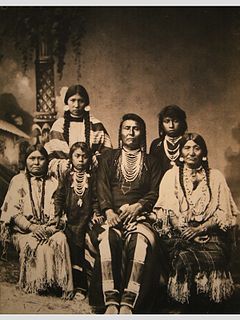
Chief
Joseph and his Family, c.1880
“Chief Joseph.” PBS, Public Broadcasting Service, 2001,
www.pbs.org/weta/thewest/people/a_c/chiefjoseph.htm.
Nabokov, Peter. Native American Testimony: a
Chronicle of Indian-White Relations from Prophecy to the Present, 1492-1992. Penguin, 1999.
“New Research Confirms
PBS The Most Trusted and Unbiased Source.” PBS, Public Broadcasting Service, www.pbs.org/roperpoll2010/.
Treuer, Anton. Atlas of Indian Nations. National
Geographic, 2014.


Hallalhotsoot or Lawyer was a leader of the Niimiipu (Nez Perce) and among its most famous after Chief Joseph. Throughout the history of white settlement Chief Lawyer was a friend of the Whites. He was the son of a chief who had met Lewis and Clarke in a friendly manner and took care of their horses during their stay down the river. Lawyer was naturally eloquent and had a lawyer-like keenness that made him famous. (Access Genealogy).
ReplyDeleteLawyer was a prominent figure in the negotiations between Governor Stevens and the discussions with the Chiefs of the Yakima, Cayuses, Nez Perce (Old Joseph), Lookingglass, and the Peu-peu mox mox regarding the sale of Indian property - they were opposed, but Lawyer was all about selling the properties. Chief Lawyer told Governor Stevens that there was a conspiracy by the chiefs to kill him which started the Yakima War. The astute Lawyer was ever afterwards held in great favor(Access Genealogy).
_______________
Reference:
Access Genealogy. (March 15, 2013). "Biography of Chief Lawyer - Nez Perce." Accessed on September 29, 2018 from: https://www.accessgenealogy.com/native/biography-of-chief-lawyer-nez-perce.htm.
Access Genealogy. (March 8, 2013). "The Yakima War (1855-56)." Accessed on September 29, 2018 from:
https://www.accessgenealogy.com/native/the-yakima-war.htm
The Nez Perce tribe dealt with many profound changes in there diminishing culture. Some Indians embraced the new religion, others did not. Though Lawyer earned his name because of his speaking and diplomatic skills, he is also known for his dedication to obeying the law (Carriker). He consistently advocated cooperation with the government and laid great emphasis on obeying the law. He led the negotiations of the treaties of 1855 and 1863, and some Nez Perce refer to him as "Red Judas" or "Uncle Tomahawk" because of his actions throughout his like (Carriker).
DeleteCarriker, Robert C. “Southern California Quarterly.” Southern California Quarterly, vol. 63, no. 1, 1981, pp. 100–102. JSTOR, JSTOR, www.jstor.org/stable/41170924.
It is interesting that you chose Chief Joseph. It is hard for me to imagine demanding the land that my parents bones would be buried on. This shows the cultural significance of land, herritage and family. I really appreciate how Chief Joseph held steadfast to his father's cultural values.
ReplyDeleteWith the oral history that is strong with these tribes, and when you see a plea of a father to a son saying not to sell the land that has the bones of family members is a strong one. Being spiritual it is very important to have these things close to them, it is sad that he had to have those dying words to his son. He knew what was going to happen, that more and more land was going to be taken away.
ReplyDelete